 Watch · 0:25
01 · Neck and back of the head · lesson 1
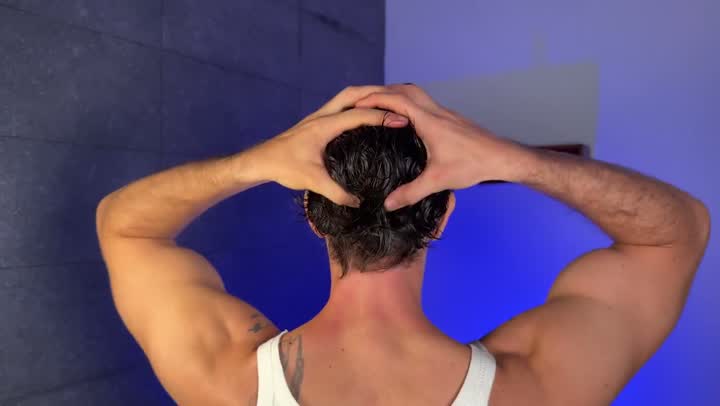
Suboccipital muscles: circular kneading with the thumbs
Your palms rest on the back of your head, four fingers of each hand on top, and only the thumbs do the work. With them you find two dense cords right at the base of the skull and knead them in small circles. This is the entry point to the whole program: as long as there’s a spasm here, nothing above it will relax.
- Reps
- 10–15 circles on one point, then shift a centimetre and repeat — 2–3 points on each side in total. One or two sets, about a minute altogether.
- How often
- Every day. In the morning to get drainage going after the night, in the evening to release the tension of the day and fall asleep more easily. Missing a day isn’t critical, but the effect builds precisely through regularity.
How to do it right
Work with the pads of your thumbs, not your nails. The pressure should feel “pleasantly painful” — about 4–5 out of 10. The circle is small, and the skin and fascia move with your thumb instead of slipping under it. Chin slightly toward your chest, neck long, breathing steady — on the exhale the tissue releases more deeply.
Common mistakes
The main mistake is letting your fingers drift sideways onto the transverse processes and the neurovascular bundle: there’s nothing to knead there. The second is “sawing” at the neck with quick movements instead of slow circles. The third is tilting your head back — the muscles shorten and you can’t press into them. And don’t work through sharp pain that shoots into your eye or ear — that’s a signal to ease the pressure.
Why it works
Under your fingers are the four short muscles of the suboccipital group: rectus capitis posterior major and minor, obliquus capitis superior and inferior. They keep the head balanced and contain a record density of proprioceptors — up to 200 spindles per gram of tissue. A myodural bridge runs from rectus capitis posterior minor to the dura mater, which is why their spasm shows up as a headache. The vertebral arteries and occipital veins run nearby: release the hypertonus and you restore blood flow to the scalp and drainage from the head.
Why this one
This is the exercise with the highest return per minute in the entire course. One minute of work changes the tone of the whole back of the head, the face literally “settles” more evenly, and the feeling of a band across the forehead goes away. People who have lived with tension headaches for years notice the difference within the first few days.
Why it is easy
You need no mirror, no oil, no special position. Your hands find the spot on their own — where the skull meets the neck, your fingers sink into a hollow. You can do it sitting at your desk, in the car, in a queue; nobody around you will even realize you’re working on your face.
What you will see
Start with exactly this point — and within a week you’ll catch the feeling that a clamp you’ve worn for years has been taken off the back of your head. From there everything gets easier: a relaxed base pays off in every exercise that follows.